The Role of the Offender in the Healing Process
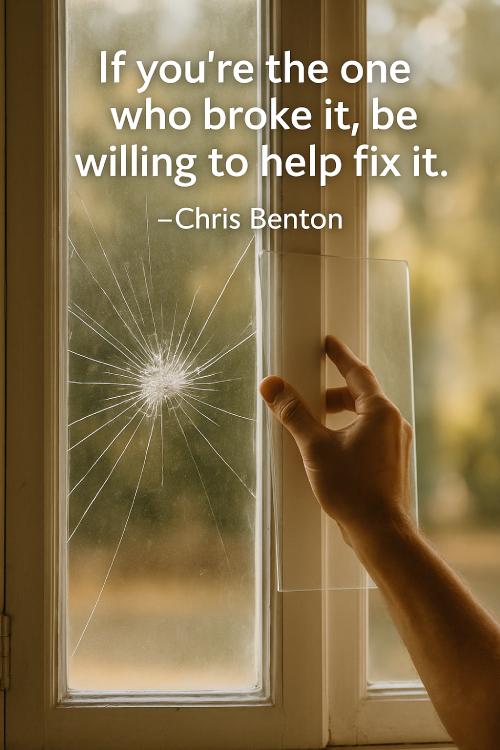
Many years ago, I had a neighbor who was mowing his lawn when a rock shot out from under the blade and shattered one of our windows.
It wasn’t intentional.
It wasn’t malicious.
But it was his rock that did the damage.
And you know what he did?
He didn’t just bring us a replacement window.
He installed it.
He didn’t just say, “Sorry I broke that.”
He rolled up his sleeves and said, “Let me help make this right.”
That small act has stayed with me for years — not because it was expensive or elaborate, but because it was ownership. He didn’t walk away from the damage he caused. He walked toward it.
And that simple truth has echoed through my own story, especially in my marriage.
🧨 When You’re the One Who Caused the Pain
There’s something many people don’t talk about when it comes to healing from broken trust, especially in marriage:
If you’re the one who caused the pain, you need to be part of the healing.
Not by controlling how they heal.
Not by demanding forgiveness.
But by staying present through the repair.
You see, when someone breaks a window in your house, you don’t just want a receipt — you want them to care. You want them to acknowledge what happened, understand what it cost you, and step into the process of making things whole again.
The same is true when trust is shattered in a relationship.
💔 The Day I Saw the Wreckage I Had Caused
After years of addiction, emotional betrayal, and the deep wounds I left behind in Sandy — the woman who loved me through more than I deserved — I finally began to heal.
God was doing something in me.
But Sandy needed healing too.
And I realized something critical:
You can’t be the one who caused the damage and then check out of the cleanup.
So one day, I sat her down and said, “Tell me. All of it. What I did. How it felt. What it cost you. Don’t hold back.”
She looked at me and said, “Are you sure?”
I nodded.
That conversation broke me — and it healed something in her.
Because up to that point, she was still carrying the weight of my actions… alone. She had been surviving in the silence, protecting me from the truth of her pain because she didn’t want to push me away.
But when I finally invited her truth in…
When I stopped defending myself…
When I chose to listen instead of justify…
That’s when the real healing began.
Not just for me.
But for us.
🔨 Repair Requires More Than Change
A lot of people say they’ve changed. They get sober. They stop cheating. They stop yelling. They stop drinking. And yes — those things matter.
But change alone isn’t enough.
Real healing takes repair — not just repentance.
Here’s what Scripture says:
“Bear one another’s burdens, and so fulfill the law of Christ.”
— Galatians 6:2
“Confess your sins to one another and pray for one another, that you may be healed.”
— James 5:16
There’s a difference between being sorry and stepping into the sorrow you’ve caused. One tries to avoid the pain. The other says, “I’ll help carry what I dropped on you.”
🪟 You Don’t Have to Have All the Tools
Back to that neighbor and the broken window…
He wasn’t a professional.
He didn’t have a perfect repair kit.
But he showed up with what he had — and that mattered.
If you’ve broken trust, hurt someone you love, or caused emotional damage through your own dysfunction — you may not know exactly how to fix it.
But you can:
- Ask to hear their pain.
- Listen without defending.
- Apologize without rushing.
- Offer your presence as part of their process.
- Pray with them — not just for them.
That’s what it looks like to be part of the rebuild.
🧱 Healing Doesn’t Happen Without Honesty
Let’s be honest: it’s easier to say “I’m not that person anymore” than it is to say “I see what I did to you, and I’m sorry.”
But if you want to be part of someone’s healing, you don’t just rebuild yourself — you show up for them, too.
Your humility is their medicine.
Your listening is their permission to speak.
Your presence is a piece of their peace.
Don’t just change your behavior — help heal the wound your behavior created.
✝️ Grace Doesn’t Excuse the Pain — It Redeems It
Grace isn’t about pretending it didn’t happen.
Grace is about saying, “It happened… and we’re going to walk through this with God together.”
That’s what Sandy and I did.
Not overnight.
Not perfectly.
But day by day, moment by moment, choice by choice.
And if God can redeem our wreckage…
He can redeem yours too.
🔚 Final Thought
You can’t undo the past.
But you can be present in the healing.
Just like my neighbor didn’t just buy a window — he helped install it — you have the chance to say, “I’m not just sorry I broke this. I’m here to help rebuild it.”
That’s what love does.
That’s what grace makes possible.
And that’s what redemption looks like.
— Chris Benton
From Rising from the RUINS